"Make a text about the water cycle"
It does not specify the level, purpose, extension or source. It can serve to explore, but leaves many open decisions.
THE INTENTION TO A CLEAR PETITION
One Soon is the request with which we orient the answer: it may include one question, instructions and context. Design it and adjust it after reviewing the result is what we call engineering soon. A clear request helps, but does not guarantee the veracity. [10] [11]
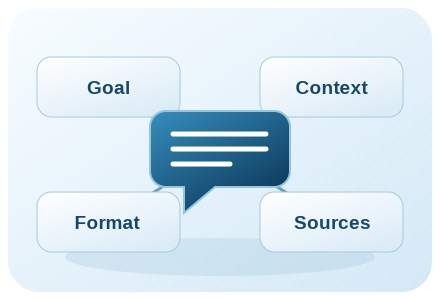
Combina objective, context, format and sources. Then, check the answer and adjust the request. [10]
The quality of the material generated by the IAG depends directly on the art of formulating good instructions. This is called "engineering of prompts". A well-designed indication is clear, concise and provides all the necessary context. Then we explore how to move from a simple indication to an expert.
"Make a text about the water cycle."
Generic and unadapted result.
[ROL] He acts as a teacher of Natural Sciences of Primary.
[ACTION] It creates an explanatory text about the water cycle.
[CONTEXT] The text is for students of 4th Primary (9-10 years) with a basic reading level.
[FORMAT] Structure it in three short paragraphs: 1. Evaporation, 2. Condensation and Precipitation, 3. Collection. Use a clear, simple language with easy to understand analogies. It ends with a question for reflection.
Specific result, structured and pedagogical.
It tells AI what personality or profession should adopt. ("Acts as a historian...").
Specifies whether language should be formal, informal, fun, etc. ("Use close tone...").
It offers one or two examples of the result you expect to guide AI.
Add clear limitations. ("Don't exceed 150 words...").
It does not specify the level, purpose, extension or source. It can serve to explore, but leaves many open decisions.
"Take an explanation of the water cycle for 1st ESO from the text I attach. Write three short paragraphs and a final question. It uses accessible vocabulary and defines new terms. Indicates which fragment sustains each idea and what cannot be concluded from the text."
RITA, CARE and RTF: three aid to order the petition
An ideal framework to quickly structure a petition, ensuring that AI understands who it should be, what to do, how to communicate it and who.
Example:
"Acts like a museum guide (Roll). It explains the importance of Picasso's 'Guernica' (Instruction) with one passionate and informative tone (To) for the first time High School Students ( Audiencia)."
Example with sources · secondary and FP
"Acts as a museum guide. Explains the context of Guernica with an informative tone for baccalaureate. Use the attached sources and identify the claims to be contrasted."
Excellent for tasks requiring precision and a specific result, guiding AI with a clear model.
Example:
"We are studying the Industrial Revolution (Context). Create (Action) a comparative table with 3 columns (advantages, disadvantages, key inventions) (Resulted). For example, an advantage could be 'Mass production' (Example)."
Example with sources · secondary and FP
"We study the Industrial Revolution. Compare two changes in a table with impact and source. As a row model, it uses: change → consequence → evidence of the dossier."
A direct and efficient model, perfect for when the task and output format are the main priority.
Example:
"You are one nutrition expert (Rool). Prepare a healthy weekly menu (Tasca) ⁇ ⁇ nested list format, separating by days and meals (dinner, dinner) (formed)."
Example with sources · secondary and FP
"Acts as a FP tutor. Creates comprehension questions about the attached manual. Presents a table with question, guidance response and support page."
Add to cart Relevant Context, an example of output, specific limits and Review Criteria. Ask for brief justifications with evidence, not just a response that sounds safe. Check the result and specify the changes. [10]
The Life of the Worldafinament o iteració consisteix a revisar una resposta i donar noves instruccions per ajustar-la a l’objectiu d’aprenentatge. No cal encertar el prompt a la primera: el docent detecta què falta, concreta el canvi i comprova la nova proposta. Aquí parlem d’afinar la conversa, no d’entrenar ni modificar el model.
Objectiu → prompt → resposta → revisió docent → nova instrucció → nova resposta → validació
Petició inicial: «Dissenya una activitat perquè l’alumnat expliqui la relació entre massa, volum i densitat.»
Abans d’utilitzar-la, comprova els càlculs, les unitats, la seguretat dels materials i si la pregunta final permet observar l’aprenentatge. Si la conversa perd un requisit, torna’l a explicitar.
Les orientacions de la Generalitat de 2024 proposen continuar la conversa per afinar respostes i revisar les propostes amb criteri docent. Consulta «La intel·ligència artificial en l’educació». L’exemple anterior és una proposta pròpia d’iAducació.
En aquest context, el metaprompting és utilitzar la IA per redactar, revisar o millorar les instruccions que després farem servir. El primer resultat que busquem és un prompt reutilitzable. El docent n’ha de revisar els objectius, el context, els límits i els criteris abans de provar-lo.
Metaprompt per copiar i adaptar:
«Ajuda’m a redactar un prompt per crear una activitat de comprensió d’un manual tècnic per a un CFGM. Abans d’escriure’l, pregunta’m quin mòdul és, què ha de saber fer l’alumnat, quin fragment del manual utilitzarem, el temps disponible i els suports necessaris. Espera les meves respostes. Després proposa un prompt amb objectiu, context, tasca, format i criteris de revisió. Inclou que les respostes s’han de basar en el fragment aportat, indicar-ne la pàgina o l’apartat i assenyalar quan hi falta informació. No generis encara l’activitat.»
Després: respon les preguntes, revisa el prompt proposat i prova’l amb el fragment del manual. Comprova que les preguntes avaluen la comprensió prevista i que les respostes es poden justificar amb el text. Si cal, itera.
Un prompt suggerit per la IA també pot ometre requisits o introduir supòsits. Revisa’l, utilitza dades fictícies o anonimitzades i valida el material resultant abans de portar-lo a l’aula.
| Pràctica | Esquema | Exemple docent breu |
|---|---|---|
| Prompting Formular la petició | Instruccions → resposta | «Crea una activitat sobre densitat per a 2n d’ESO.» |
| Iteració Revisar i ajustar | Resposta → revisió → nova instrucció → resposta revisada | «Adapta aquesta activitat a 40 minuts i afegeix una pregunta individual de justificació.» |
| Metaprompting Dissenyar la petició amb ajuda de la IA | Objectiu i context → ajuda de la IA → prompt revisat pel docent → prova | «Fes-me preguntes i ajuda’m a redactar un prompt per dissenyar aquesta activitat.» |
No són fases obligatòries ni excloents: pots començar amb metaprompting, provar el prompt i iterar sobre el resultat. En tots els casos, la validació final és humana.
Fill the fields with fictitious or general information. The template is made in the browser, without sending the data no service.
You can edit the result before copying it.
Documentary update: 19/10/2026 · Department orientations, September 2026 edition. The dates of consultation of the other sources are preserved.